
The Collapse
April 7-16, 1945

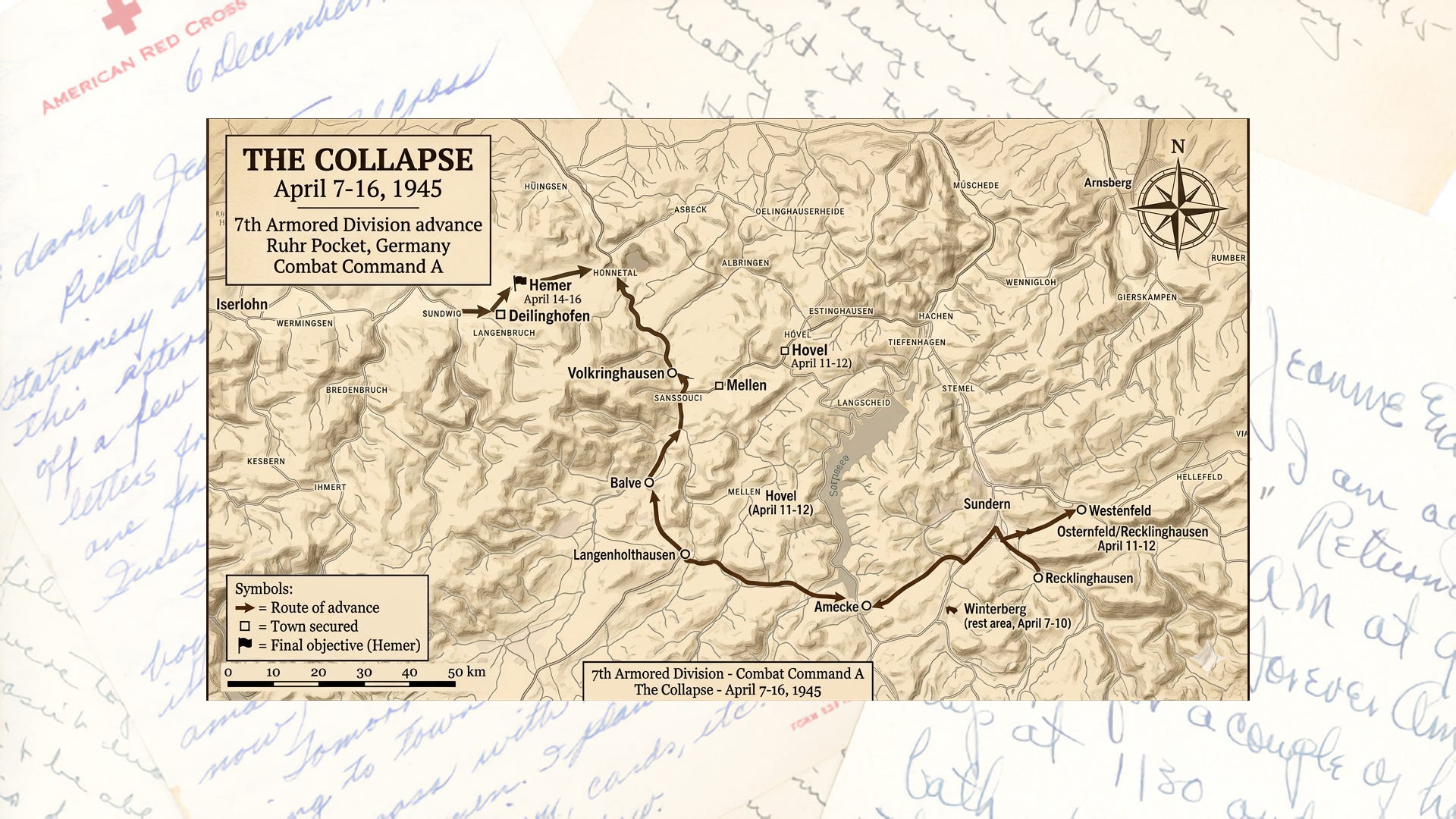
On April 7th, Jack’s Company C was released back to the 17th Tank Battalion at Winterberg for a brief rest. The battalion had been in battle every day since April 2nd.
Jack wrote to his parents: “Company ‘C’ is a good unit, and I am pleased with their combat action. We’re getting a slight pause for station identification and a little rest for a few days.”
The rest didn’t last long. By April 11th, the 7th Armored Division was attacking again, task forces leapfrogging through the mountains southeast of Essen. The Wehrmacht was collapsing. Town after town fell with minimal resistance, and thousands of Germans simply surrendered.
On the night of April 12th, President Roosevelt died in Warm Springs, Georgia. The American public grieved, but in Berlin, there was a different reaction.
As bombs rained down on the city, Joseph Goebbels took great delight in calling Hitler with the news that a miracle had arrived to save the Third Reich.
“Mein Führer!” Goebbels exclaimed. “I congratulate you! Roosevelt is dead.”
Two days later, Hitler issued a proclamation: “At the moment when fate has removed the greatest war criminal of all time from the earth, the turning point of this war shall be decided.”
There was no turning point. The Ruhr Pocket continued to collapse around them.
By April 15th, Field Marshal Walther Model, commanding general of German Army Group B, knew the situation was hopeless. An aide to General Matthew Ridgway met with Model and asked him to surrender. Model refused.
His chief of staff asked him to contact Hitler for permission to surrender. The Field Marshal knew what the Führer’s answer would be, and he knew as well that he could not personally surrender because of all the sacrifices he had asked of his officers and troops over the years. He struggled to solve this problem, believing every life saved could help rebuild Germany. He decided to dissolve Army Group B. There could not be a formal surrender of a command that no longer existed.
Field Marshal Model decreed that all youths and older men were immediately discharged to go home. When ammunition and supplies ran out, non-combatants would be free to surrender, and combatants could either fight in organized groups to escape the pocket or make their way home in civilian clothes without weapons.
The Wehrmacht in the Ruhr Pocket wasn’t just collapsing, it was dissolved, Field Marshal Model had ended it without officially ending it, and tens of thousands of German soldiers simply stopped fighting and went home.
During the last few days of the collapse, Field Marshal Model asked his chief of staff, “What is left for a commander in defeat?” He paused, then answered his own question. “In ancient times, they took poison.”
Those who knew him intimately knew he would never surrender. He had been critical of Field Marshal Friedrich Paulus for becoming a Russian prisoner at Stalingrad. “A Field Marshal can’t do that. Such a thing is just not possible.”
Five days later, on April 21st, Field Marshal Model walked into the woods near Duisburg with his aide and shot himself. When his body was found, there was a note asking that he be buried where he fell, not in a military cemetery.
Share with us:
What stories did your family carry home from the war?
The full story: Jack’s Story on Amazon